
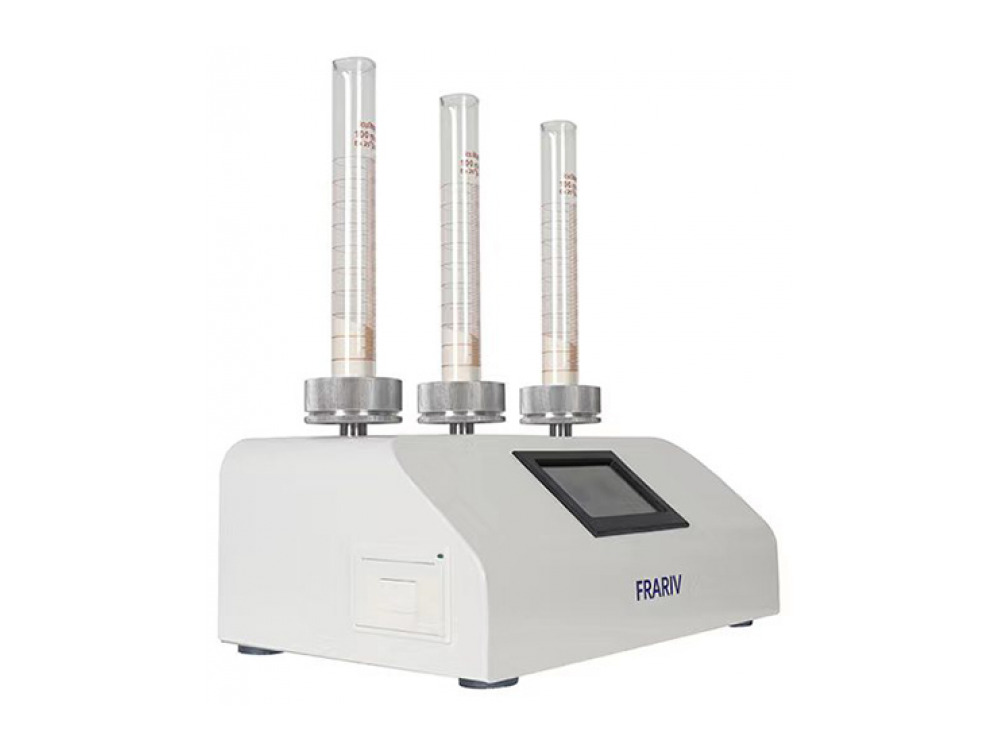
The Pharmacopoeia Tapped Density Tester, Standard model, determines the bulk density and tapped density of powders for drugs and excipients by USP General Chapter 〈616〉 Bulk Density and Tapped Density of Powders. This chapter is interchangeable with Ph. Eur. 2.9.34 and JP 3.01 under ICH Q4B. The instrument taps while rotating. Models are the single-station C100M, the dual-station C200M, and the triple-station C300M. Except for the number of stations, C200M and C300M have the same parameters as C100M. The instrument has a 4.3-inch touch display and a built-in receipt printer. Results are expressed to 0.001 g/mL and can be exported as Excel or PDF.
Method
USP 〈616〉 gives three methods for tapped density. Methods 1 and 2 measure the tapped volume of a sample of known mass. Method 3 measures the mass of powder tapped in a vessel of known volume.
- Method 1 uses a 250 mL cylinder. The tap frequency is 250±15 taps/min with a drop of 3±0.2 mm, or 300±15 taps/min with a drop of 14±2 mm. The same sample is tapped 10, 500, and 1250 times.
- Method 2 uses a fixed drop of 3.0±0.2 mm and a tap frequency of 250±15 taps/min.
- Method 3 uses a capped measuring vessel, not the 250 mL cylinder, at 50–60 taps/min, for 200 taps and then 400 taps. The vessel is supplied only when ordered. It is not standard equipment on this page.
Bulk density is the mass per unit volume of the powder in a loose state. Tapped density is the mass per unit volume after tapping. Both are in g/mL. The operator enters the mass m and the volumes. This instrument does not weigh the sample. Hausner ratio = tapped density / bulk density. Compressibility index (Carr index) = 100 × (tapped density − bulk density) / tapped density.
Read the volume to the nearest graduation. The report states the tap frequency, drop height, and number of taps. Bulk density has limited reproducibility, and the result depends on the conditions of measurement.
Specifications
| Stations | Single | Dual | Triple |
|---|---|---|---|
| Model | C100M | C200M | C300M |
| Method | USP 〈616〉. Methods 1 and 2 use the conditions above. The capped vessel for Method 3 is supplied only when ordered | ||
| Sample | Powders of drugs and excipients. Tapped density of metal powders follows a different standard and is not covered by the pharmacopoeial conditions on this page | ||
| Tapping action | Rotating and tapping | ||
| Tap frequency | Settable, not exceeding 300 taps/min. Method 1 uses 250±15 or 300±15 taps/min. Method 2 uses 250±15 taps/min. Method 3 uses 50–60 taps/min with the optional vessel | ||
| Drop height | Two settings, 3 mm and 14 mm. Method 1 uses 3±0.2 mm or 14±2 mm. Method 2 uses 3.0±0.2 mm | ||
| Number of taps | For Methods 1 and 2, 10, 500, and 1250 taps, with further taps until the difference between two successive volumes meets the chapter | ||
| Cylinder | 250 mL is supplied. For Methods 1 and 2 the chapter calls for a 250 mL cylinder readable to 2 mL and weighing 220 g±44 g. A 100 mL cylinder is allowed when the sample is less than 100 g. A 100 mL cylinder is not standard equipment on this page | ||
| Result | g/mL, expressed to 0.001 g/mL | ||
| Power supply | AC100-240V 50/60Hz | ||
Except for the number of stations and the model, C200M and C300M are the same as C100M.
Features
- 4.3-inch touch display;
- Built-in receipt printer;
- After the operator enters mass and volume, the instrument calculates bulk density, tapped density, Hausner ratio, and compressibility index;
- Results expressed to 0.001 g/mL, with Excel and PDF export;
- Remote software upgrade.
Instrument layout (single station)
| Part | Description |
|---|---|
| Cylinder | Placed on top, holds the sample |
| Display | Touch display on the front |
| Built-in printer | On the left side of the housing |
| Tray | On top, supports the cylinder |
| Fan | On the back, for cooling |
| Power switch | On the back |
| RJ45 port | On the back, for network connection |
Operating screen
The main screen has a test monitor and a calculation section. The operator enters the mass and the volumes.
| Test monitor | Tap frequency (taps/min), duration (min), and number of taps; a progress bar shows completion |
|---|---|
| Operator entry | Mass (g), bulk volume (mL), tapped volume (mL) |
| Results | Number of taps, bulk density (g/mL), tapped density (g/mL), Hausner ratio, compressibility index |
| Controls | Back, print |
- Tap frequency and duration are stored and shown at start-up;
- The number of taps is calculated automatically;
- Chinese and English input;
- A progress bar shows the test;
- Hausner ratio = tapped density / bulk density. Compressibility index = 100 × (tapped density − bulk density) / tapped density;
- The report records tap frequency, drop height, and number of taps, and can be printed in one step.