
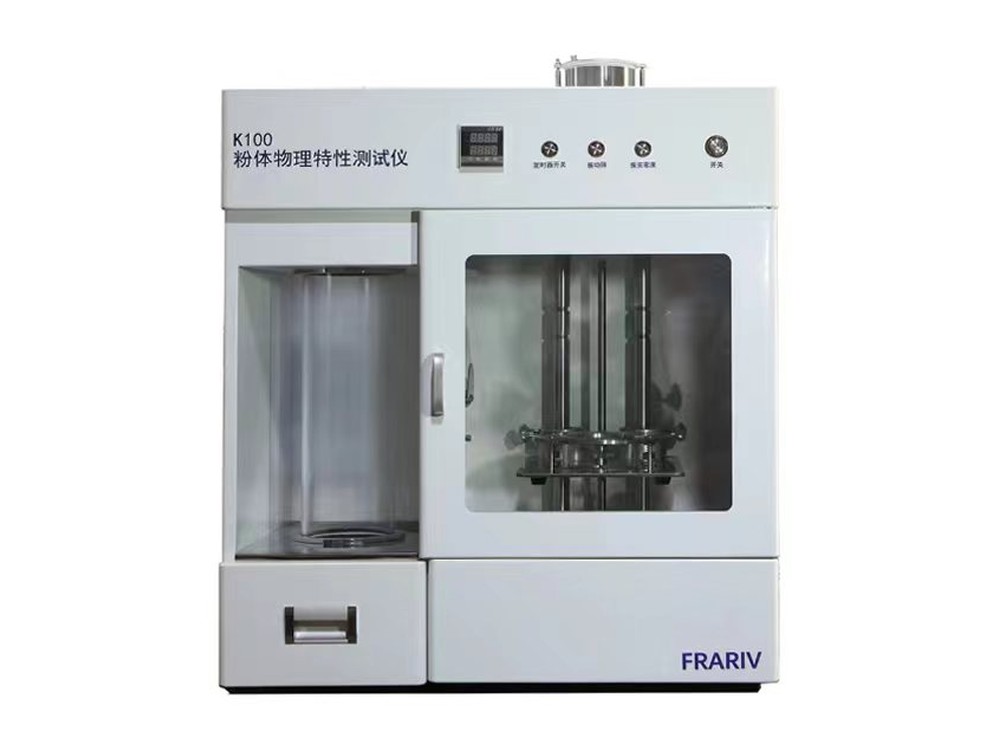
The K100 powder flowability tester is designed to evaluate the comprehensive physical properties of powders to the standards below.
Introduction
The referenced standards include:
- ASTM D6393-99 (Standard Test Method for Bulk Solids Characterization by Carr Indices);
- GB/T 5162-2006/ISO 3953:1993 (Metallic powders — Determination of tap density);
- GB/T 1482-2010 (Metallic powders — Determination of flow rate by means of a calibrated funnel);
- GB/T 1479.1-2010 (Metallic powders — Determination of apparent density — Funnel method);
- GB/T 16913-2008 (Determination of bulk density by natural accumulation).
Measured items
1. Tapped density
Tapped density is the density after a powder in a specified container is vibrated under defined conditions so that voids are reduced and the powder is more closely packed. It is generally lower than the true density of a single particle.
This tester provides the tapped-density methods specified in:
- ASTM D6393-99 (Carr indices);
- GB/T 5162-2006 / ISO 3593:1993 (Metallic powders — Determination of tap density).
2. Bulk (apparent) density
Bulk density is the density after powder fills a specified container under defined conditions without extra vibration or force. It is important for storage containers and packaging.
This tester provides three methods:
- ASTM D6393-99 (Carr indices);
- GB 1479-2010 (Metallic powders — Determination of apparent density — Funnel method);
- GB/T 16913.3-2008 (Determination of bulk density by natural accumulation).
3. Angle of repose
The angle of repose is the maximum angle between the free surface of a powder heap in static equilibrium and the horizontal plane, formed when powder falls naturally onto a platform. A smaller angle means better flowability. It is also called the angle of rest or natural slope angle.
This tester provides the method specified in ASTM D6393-99 (Carr indices).
4. Angle of fall
After an impact is applied to the heap used for the angle of repose, the base angle of the remaining cone is the angle of fall.
The K100 provides the method specified in ASTM D6393-99 (Carr indices).
5. Cohesion
Cohesion is the mutual attractive force on particle surfaces. Dry powders generally have low cohesion.
6. Uniformity
Uniformity is another expression of cohesion. When cohesion cannot be measured, uniformity is used to express the agglomerating force.
7. Spatula angle
The spatula angle is the average of the angle between the free surface of powder on a plate lifted vertically from the powder and the plate, and the angle after vibration. In practice it is the average of the angle after lifting and the angle after impact has removed unstable powder. A smaller spatula angle means better flowability. It is generally larger than the angle of repose.
This tester provides the method specified in ASTM D6393-99.
8. Dispersibility
Dispersibility describes how readily a powder disperses, floods or fluidizes. 10 g of sample is dropped from a set height, and the percentage of sample outside the receiving pan is measured. It relates to dispersion, floating and splash. A value above 50% indicates a strong splash tendency.
This tester provides the method specified in ASTM D6393-99.
Calculated items
1. Angle of difference
The difference between the angle of repose and the angle of fall. A larger value means stronger flowability and floodability.
2. Compressibility
The difference between tapped density and bulk density of the same sample, divided by tapped density. Also called the compression ratio. A smaller value means better flowability.
3. Voidage
The percentage of voids in the powder volume. It varies with particle shape, packing and size. Spherical particles are typically around 40%; ultrafine or irregular particles may reach 70–80% or more.
4. Flowability index
The flowability index was defined by Carr in the 1960s from a large set of powder measurements, using a weighted combination similar to fuzzy comprehensive evaluation. It is the weighted sum of angle of repose, compressibility, spatula angle, uniformity and cohesion.
5. Floodability index
The floodability index describes how readily a powder generates dust and how easily it is fluidized. A high value means the powder dusts easily and is easily fluidized. It is the weighted sum of the flowability index, angle of fall, angle of difference and dispersibility.
Calculation software
- The K100 Calculator is available in the download center for measured and calculated items;
- Currently for Windows;
- Free to use.